
Why Your MRI Doesn't Always Match Your Pain
Here's something that trips a lot of patients up: why does one person with severe disc damage on their MRI barely notice it, while someone else with mild damage can barely get through the day? If you've looked at your own MRI report and felt like it didn't quite match what you're actually feeling, you're not imagining that. There's a real reason for the mismatch.
Dr. Brent Ungar at Advanced Disc and Joint Solutions in Canton, Ohio, hears a version of the same complaint constantly: "I got my MRI, and nobody explained what's actually happening on the films. They just read me the report." The Surprising Truth About MRI Results
More damage on an MRI doesn't always mean more pain. Less damage doesn't mean you should be hurting less. Sounds backward, but it's one of the most consistent findings in patients with disc-related problems.
The reason comes down to something simple. Every level of your spine has a nerve that exits and travels to the rest of your body. Whether a disc is actually pressing on that nerve, and how much, is what really determines how you feel. The size of a herniation on paper matters a lot less than its exact position relative to the nerve running right next to it.
Two Patients, Same MRI, Completely Different Lives
Picture two patients with nearly identical MRIs. One has a significant herniation, with a disc clearly bulging outward. But it isn't touching the nerve. This patient is stiff, sore, tight; movement is limited, but they're managing. They get through a day.
The other patient has what appears to be moderate, or even mild, damage on the same type of scan. Smaller herniation, less dramatic image. But the disc is sitting directly on top of the nerve. For this person, getting through a normal day feels next to impossible.
Same diagnosis, essentially the same paperwork, completely different lives. Go by the size of the herniation alone, and you'd guess the first patient was suffering more. Wrong guess. It's not the amount of disc damage that decides how someone feels. It's whether and how much that damage is touching a nerve.
What an MRI Can and Can't Tell You
An MRI is genuinely useful. It shows which structures are affected, where a disc is bulging or herniated, and gives a real picture of what's happening inside your spine. It also has limits, and those limits are exactly where many patients are left with more questions than answers.
An MRI doesn't clearly show nerve involvement. It doesn't show inflammation, which can cause significant pain even when the physical structure looks stable. And it doesn't show how long a disc has actually been under pressure, which matters because a nerve irritated for months behaves differently than one that was just recently compressed.
That's what's missing when someone hands you a report without walking you through it. The report can tell you a disc is herniated. It can't tell you why that herniation is affecting you the way it is, or why your neighbor with a "worse" MRI seems to be doing fine.
Why the Full Picture Matters More Than the Films Alone
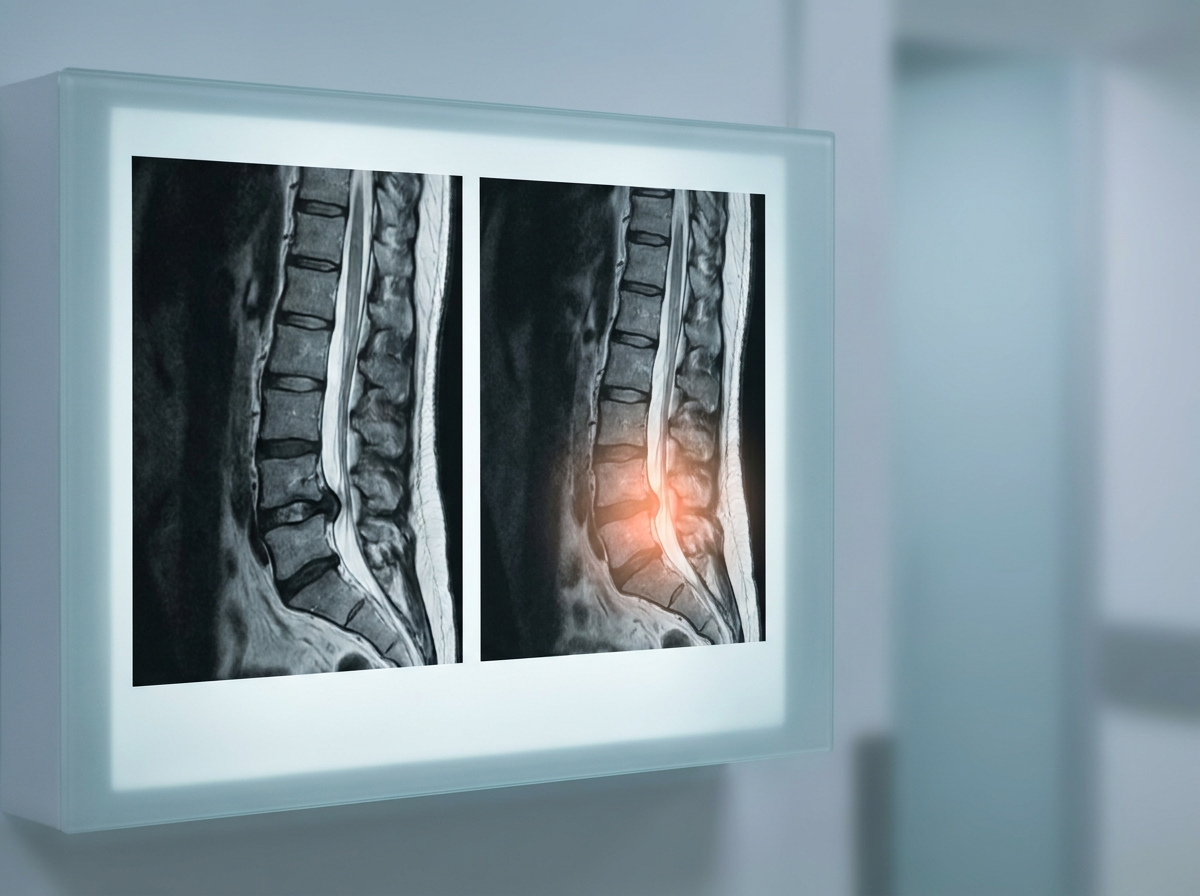
The MRI alone can't explain the mismatch between damage and pain, so looking at the image by itself was never going to answer much. At Advanced Disc and Joint Solutions, the approach starts somewhere else first: your history, your symptoms, the way you move, your reflexes. The imaging comes into the conversation after that.
Your history tells a story the MRI can't. How long you've been hurting, what makes it better or worse, whether it started suddenly or crept in slowly. Your symptoms, where the pain shows up, whether there's numbness or tingling, whether it moves around, point toward which nerve is actually involved. How you move and how your reflexes respond give a functional picture of what's really going on, information no static image can capture on its own.
Put all of that together with the MRI and a clearer picture shows up. The films show what structures are affected. Everything else shows how those structures are actually affecting you day to day.
Why This Matters for Your Own Pain
If you've been handed an MRI report full of medical language and not much explanation, or your damage looks "mild" but your pain feels anything but, this is exactly why. The size of what's on the film was never the whole story. Whether it's touching a nerve, how long it's been doing that, and what your body is actually experiencing matter just as much, sometimes more.
Don't dismiss your own pain just because someone told you your MRI "doesn't look that bad." Don't assume the worst just because your MRI shows significant damage, either. Neither number tells the full story on its own.
Getting the Full Picture for Your Own Situation
If you've had an MRI and left with more confusion than clarity, or your pain doesn't match what you were told about your scan, it's worth getting a full evaluation instead of just a reading of the report. Dr. Ungar and the team at Advanced Disc and Joint Solutions look at your history, your symptoms, your movement, and your reflexes alongside your imaging, so what you walk away with is an actual explanation, not just a paragraph of medical terminology.
If you're in the Canton or Jackson Township area and you're ready to understand what your MRI actually means for you, request a consultation with Advanced Disc and Joint Solutions at 330-302-1217 or visit advanceddiscandjointsolutions.com. Together, we'll look at the full picture and figure out what's really going on.