
When Your Back Pain Has Stopped Responding to Everything Else
If you have been dealing with low back pain for months, maybe years, you already know how exhausting it is to keep trying things that don't work. You've probably rested. You may have done physical therapy, tried anti-inflammatory medications, or sat through injections that gave you a few weeks of relief before the pain crept back. And somewhere along the way, someone may have mentioned surgery. It's a discouraging cycle, and it leaves a lot of people wondering if they're simply stuck.
At Advanced Disc and Joint Solutions in Canton, we hear this story often. And the reason we do what we do is because there is a middle ground that most people never hear about: nonsurgical spinal decompression. A recent study published in the peer-reviewed journal Military Medicine looked at 267 patients across seven clinics who went through this type of care, and the results are worth talking about. Not in clinical language, but in plain terms that actually matter to someone living with back pain every day.
What Is Nonsurgical Spinal Decompression, Really?
Before getting into what the research found, it helps to understand what this treatment actually is. Nonsurgical spinal decompression is a therapy that gently stretches the spine using a specialized table and a controlled pulling force. The goal is to take pressure off the discs in your spine, those cushion-like structures between each vertebra that can bulge, herniate, or wear down over time.
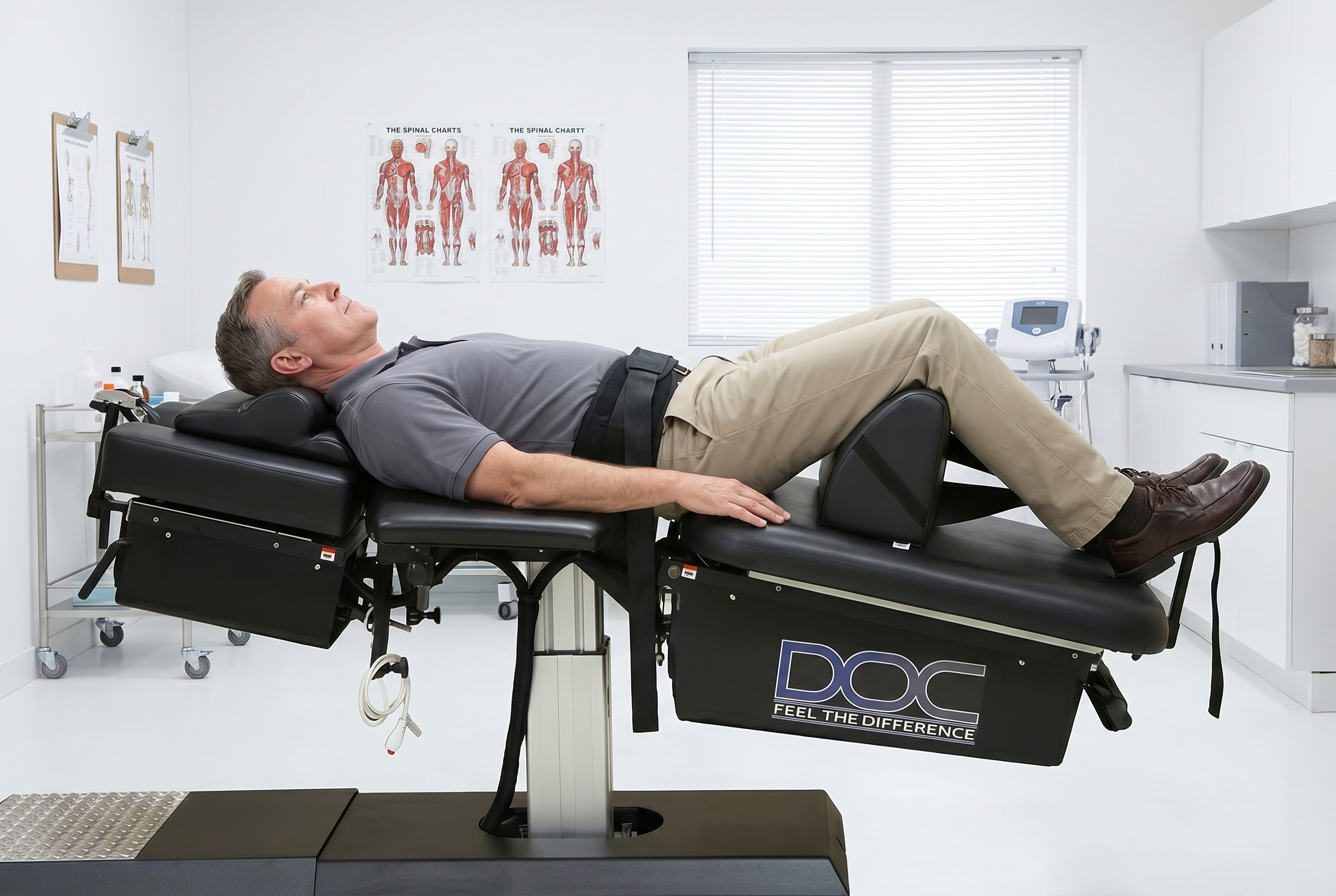
Think of a disc like a jelly donut. When pressure builds up from everyday life, poor posture, or injury, that jelly gets pushed outward, and it can press on nerves or the surrounding tissue, which causes pain, numbness, tingling, and weakness. Spinal decompression is designed to create a gentle negative pressure inside the disc, giving the jelly a chance to pull back and giving the disc space to heal. Patients lie on a comfortable table, a harness is fitted around their lower body, and the machine does the work. Most sessions last around 28 minutes and are described as relaxing by many patients.
This is not traction in the old sense. Modern nonsurgical decompression equipment is computer-controlled and calibrated to each person's weight and the specific disc level being targeted. It is gentle, non-invasive, and requires no recovery time.
What the Research Actually Found
The study reviewed real patient records from clinics around the country to evaluate what actually happened to people who went through nonsurgical spinal decompression care. Here is what stood out.
Pain dropped dramatically. Before treatment, patients rated their pain at an average of nearly 7 out of 10. After completing their sessions, that number fell to about 2.5. That is a reduction of more than 4 full points on the pain scale, and more than 90 percent of patients reported that their pain decreased.
Neurological symptoms improved as well. Many people with disc problems experience more than just pain. Numbness, weakness, and changes in sensation are common when a disc is pressing on a nerve. The study tracked improvements in these areas, and the results were meaningful. About 61 percent of patients with abnormal reflexes saw those reflexes normalize. Muscle weakness improved in 75 percent of the patients who had it before treatment. Sensation issues resolved in more than 77 percent of cases.
Daily life got easier. The researchers also looked at real-world function: could patients walk without pain? Could they sit or stand without suffering? Could they get dressed, do household chores, and take a shower? Across all of these categories, the majority of patients reported significant improvement after treatment. The ability to sit and stand without pain saw one of the greatest improvements of all.
Perhaps most encouraging is this: it didn't matter how long someone had been in pain. Whether a patient had been dealing with back pain for two months or five-plus years, the outcomes were consistent. The treatment worked across the board.
Why So Many People Skip This Step
One of the reasons nonsurgical spinal decompression isn't more widely known comes down to how our healthcare system is set up. It isn't typically covered by insurance, which means it doesn't always come up as a recommendation from a primary care doctor. Many patients end up on a path from medication to injections to surgery without anyone mentioning that conservative, non-invasive options exist.
The research points out something important here. About one in five patients who undergo back surgery develop what is called failed back surgery syndrome, meaning their pain persists or worsens even after the procedure. The costs of spinal surgery are also substantial, often ranging from tens of thousands of dollars into six figures. And once you have had surgery on your spine, the door to other options may look different.
The study's authors argue that nonsurgical decompression deserves to be considered as a first step for disc-related pain, not as a last resort. A first step that is far less expensive, carries no surgical risk, and has no recovery downtime. At Advanced Disc and Joint Solutions, that is exactly the philosophy behind the care we provide.
Who Is a Good Candidate for This Type of Care?
The patients in the study had a wide range of diagnoses. They included people with herniated discs, bulging discs, degenerative disc disease, sciatica, and spinal stenosis. They were men and women, ranging widely in age. Some were dealing with pain that had just started; others had been managing it for years.
If you have back pain that radiates into your hip, leg, or foot, if you have been told you have a disc problem, or if you feel like your options are narrowing and surgery is being presented as the logical next step, it may be worth having a conversation about whether nonsurgical decompression is appropriate for you.
That conversation starts here, in Canton. At Advanced Disc and Joint Solutions, we take time to understand your history, review any imaging you have, and give you an honest assessment of whether this kind of care is likely to help. We do not believe in rushing anyone into a treatment plan. We believe in helping you understand your options so you can make the decision that is right for your body and your life.
What to Expect If You Come In
A typical course of care in the study involved about 20 sessions over six to eight weeks, with two visits per week. Each visit is short and requires nothing from you except to lie still and let the equipment do its work. There is no pain during treatment. Many people find the sessions to be a welcome break in their day.
Progress is tracked throughout. We want to know how your pain is responding, how your daily activities are changing, and whether you are seeing the improvements you came in for. Communication is part of how we work at Advanced Disc and Joint Solutions, and you will never feel like you are just going through the motions.
Results, of course, vary from person to person. What the research tells us is that for a broad range of patients with disc-related back pain, this approach has shown consistent, meaningful improvement, not just in pain scores, but in the ability to live your life the way you want to.
You Don't Have to Keep Living With This
Living with chronic back pain changes everything. It changes how you sleep, how you move, how you show up for the people around you. It can make you feel like your body has become your limitation. And when treatments haven't worked, it's easy to believe that nothing will.
That belief is one of the most common things we hear at Advanced Disc and Joint Solutions, and it's also one we have had the privilege of helping to change. The research is catching up to what patients in our care have already experienced. Nonsurgical spinal decompression is not a fringe therapy or a last-ditch effort. For the right patient, it can be the first real solution they've tried.
If you're in the Canton area and you are ready to have that conversation, we are ready to listen.
Contact Advanced Disc and Joint Solutions today to schedule a consultation. Our team will take the time to understand your situation and help you figure out whether nonsurgical spinal decompression is the right fit for you. Relief is possible, and we would love to help you find it.